
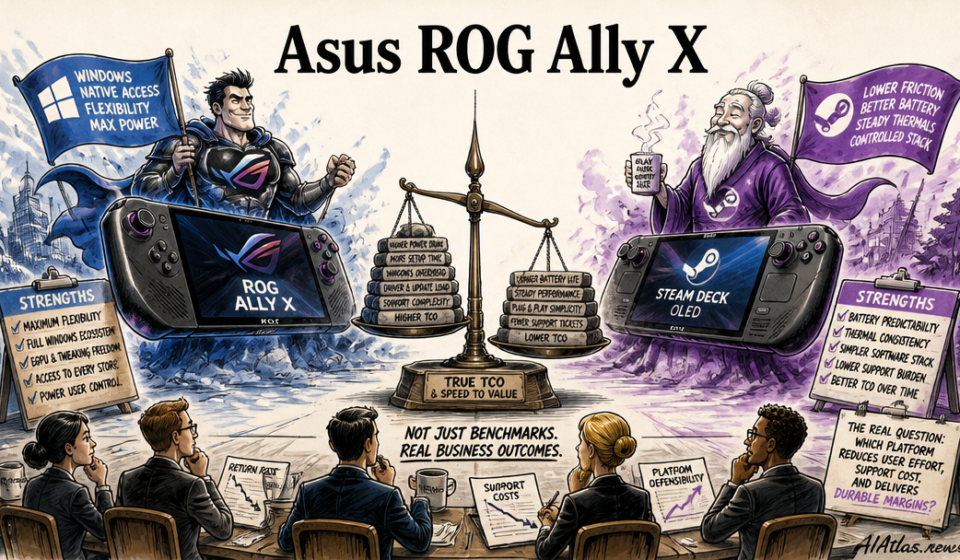
Asus ROG Ally X vs. Steam Deck OLED: The May 2026 Performance Showdown
We keep seeing the same commercial story in portable PC hardware: buyers don’t actually pay for “frames per second” — they pay for time, troubleshooting, heat discomfort, charger dependency, and the quiet operational drag of updates and compatibility edge-cases. In our experience reviewing handheld PCs through a business lens, the winners are the devices that reduce total cost of ownership (TCO) and deliver speed-to-value without forcing staff into hardware-tuning rituals.
That’s why the May 2026 hands-on findings around the ROG Ally X and the latest real-world synthesis on the Steam Deck OLED don’t read like a gamer-spec shootout. They read like a procurement decision: one system is more flexible by design but tends to impose ongoing overhead; the other is more opinionated, but it consistently ships a predictable, lower-friction operating model.
The Contrarian Thesis
In our view, the ROG Ally X can make sense as a “portable Windows workstation in a bag”, but it rarely makes sense as a low-maintenance operator tool. The Steam Deck OLED, by contrast, is still the stronger commercial choice for buyers who value reduced setup time, stable suspend/resume behaviour, and minimal support burden — especially when the device will be handed to non-enthusiast users.
Yes, the Ally X may win on raw flexibility: Windows-native access, broader storefront coverage, and fewer Proton/compatibility detours. But the Deck OLED’s advantage is structural: SteamOS stability, a tightly integrated hardware/software envelope, and community-tested reliability that converts into lower incident rates and fewer “help desk” escalations. That’s the difference between buying hardware and managing an operational asset.
Flaws in Current Market Assumptions
The industry chatter around handheld PCs still overweights headline performance states and underweights performance consistency. May 2026 reviewer findings on the ROG Ally X’s battery efficiency and sustained performance reinforce a familiar pattern: even when short bursts look impressive, long sessions tend to reveal compounding friction — battery drain that pushes you back to the charger, thermals that force fan behaviour into audible territory, and Windows background activity that interrupts your “set and forget” expectation.
Meanwhile, the Steam Deck OLED’s real-world usage tests (including long-session battery trials) continue to highlight a different kind of value: the ability to deliver an acceptable performance envelope with fewer user interventions. When Deck OLED reviewers talk about battery life, display quality, and suspend/resume performance, the subtext is operational. Suspend actually suspends, resumes don’t feel like a gamble, and SteamOS updates tend to land without turning every weekend into a regression test. For business buyers, that’s not “nice-to-have”; it’s the product.
The Structural Shift
We’re watching a structural split between two operating models. The Ally X is fundamentally Windows-first: it offers broad application access, but it inherits Windows’ entire lifecycle — driver cadence, background services, update friction, and per-game compatibility variability (particularly with anti-cheat and DRM edge cases). Even when Windows usability is “good”, it’s still a system that often asks the user to manage it.
The Steam Deck OLED is SteamOS-first. That matters because Valve’s approach creates a narrower state space: fewer power-plan surprises, fewer “why did this update break controller input?” moments, and a more predictable suspend/resume pipeline. In May 2026-era community reliability reports, the Deck OLED’s “low incident” reputation repeatedly shows up around exactly the operational points leadership cares about: thermals that don’t spike into discomfort, fan ramp that users tolerate for hours, and game compatibility paths that are largely well mapped via Proton/Steam verification.
Decision Framework for Capital Allocation
If you’re funding devices for demos, creator workflows, field testing, or portable edge-compute adjacent tasks (including local tooling and offline media prep), you should score each unit on TCO and speed-to-value, not just throughput. We use a simple procurement lens: time-to-first-use, ongoing maintenance burden, charger dependency, and support surface area.
Under that model, the Ally X is “high optionality, high management”. The Deck OLED is “moderate optionality, low management”. Flexibility is valuable when your team has time to tune and troubleshoot; it’s expensive when they don’t. This is the same capital allocation logic investors apply to edge compute: a more capable platform often raises operating overhead — and the business pays for that overhead every cycle.
| TCO / Speed-to-Value Factor | ROG Ally X (Win-native flexibility) | Steam Deck OLED (Deck-first stability) |
|---|---|---|
| Setup time & initial tuning | Usually higher: Windows setup, updates, per-game performance tuning and power-profile choices | Usually lower: SteamOS onboarding and smoother “install-and-play” flow |
| Battery efficiency at sustained load | Improved in findings versus earlier Ally iterations, but sustained play still trends toward earlier charger dependency | Reported long-session battery behaviour is more consistent; fewer “power panic” moments in typical verified titles |
| Thermals, noise comfort, and fan behaviour | Thermals more demanding under load; fan ramp can become the limiting comfort factor for long sessions | Typically calmer comfort profile; fan behaviour feels more controllable across extended play loops |
| Suspend/resume reliability | Windows suspend/resume variance can require user checks; background apps occasionally complicate resume | SteamOS suspend/resume performance remains a standout for real-world operator reliability |
| Game compatibility & support burden | Windows-native access helps, but anti-cheat/driver/app conflicts can create “incident” work | Steam verification/Proton mapping reduces surprises; lower escalation rate in community reports |
Risk Assessment Table
When procurement is serious, we treat device choice like vendor risk. The goal is not to “win specs”; it’s to limit operational variance. Below is how we’d frame the biggest category risks after synthesising hands-on feedback, benchmark round-ups, and the kind of community reliability notes that usually appear only after months of use.
These are directional assessments — but they align with what buyers experience when they move from enthusiastic testers to real operators who need predictable outcomes.
| Operational Risk | ROG Ally X Risk | Steam Deck OLED Risk |
|---|---|---|
| Update/regression friction (drivers, Windows components) | High | Low-to-medium |
| Charger dependency in mixed real-world sessions | Medium-to-high | Low-to-medium |
| Thermal/noise discomfort over multi-hour cycles | Medium-to-high | Low-to-medium |
| Compatibility incidents (anti-cheat, storefront quirks) | Medium | Low-to-medium (with caveats) |
| Support burden per user / per month | Medium-to-high | Low |
Visualised Impact Matrix (div)
To make this concrete for decision-makers, we map each device on two commercial axes: Windows-native flexibility (how easily you can run “anything”) versus operational friction/TCO risk (how much ongoing management you typically absorb). In our synthesis, Ally X shifts rightward on flexibility but up on friction; Deck OLED shifts left on flexibility but down on friction.
That’s the strategic shape of the trade-off: one unit reduces constraints; the other reduces hassle.
Strategic Recommendations for Leaders
If you’re making a buying call for organisations — not a single enthusiast unit — we recommend treating the Ally X as a specialist tool. Use it where Windows-native access is genuinely required (certain enterprise software, specific non-Steam PC titles, or workflows where you expect to script installs and manage settings centrally). Budget time for tuning requirements, and expect update friction to be part of the operating model.
If instead you’re equipping operators who need portability with minimal disruption, the Steam Deck OLED should be your baseline. The combined effect of SteamOS stability, the Deck’s more dependable suspend/resume performance, and the lower thermal/noise comfort burden translates into fewer interruptions across a day’s schedule. Pricing matters here too: across typical availability windows, Deck OLED configurations tend to undercut Ally X once you factor in likely accessories and the time cost of ongoing “fixes”.
Future-Proofing the Business Model
Future-proofing in handheld PCs isn’t about whether the silicon can run “tomorrow’s titles”. It’s about whether your staff can keep the device productive across OS updates, driver changes, and evolving anti-cheat compatibility. The Steam Deck OLED’s ecosystem lock-in is real — but it’s also the source of predictability. For many businesses, predictability is the real protection against churn.
The Ally X’s lock-in is less visible but still present: you’re effectively locked into Windows’ maintenance cycle and into the ongoing effort required to keep performance consistent. The May 2026 findings around battery efficiency and sustained behaviour may improve your expectations, but they don’t erase the fundamental commercial reality: higher flexibility typically means higher operational variance. From a TCO standpoint, that variance is expensive even when the purchase price looks favourable.
Frequently Asked Questions
- Which device has the better speed-to-value for teams?
- Steam Deck OLED. In our synthesis, setup and day-to-day operation demand less tuning and produce fewer update-related surprises, so teams can start using units immediately with lower support overhead.
- Does the ROG Ally X outperform the Deck OLED once you optimise?
- Often, yes for specific use cases, because Windows-native access and flexible configuration can deliver excellent performance in selected titles. The trade-off is that optimisation and maintenance typically consume more staff time.
- What’s the biggest hidden cost when deploying these devices?
- Operational friction: charger dependency, thermals/noise comfort during long sessions, and regression risk from OS/driver updates. For many organisations, that time cost outweighs small differences in headline benchmarks.