The Prompt Engineer Is Dead: Context Engineering Is the New Operating Layer for AI Agents
We’re seeing a quiet but consequential shift in how buyers talk about “prompting”. The term may still appear in slides, but the real procurement question has moved on: can you engineer context, manage tool access, and prove reliability under cost pressure?
In our experience, the industry is no longer re-labelling “better prompts”. It’s operationalising agents as software infrastructure—complete with retrieval pipelines, memory models, workflow state, evaluation harnesses, policy controls and observability. That change matters commercially because it turns experimentation budgets into delivery budgets.
The Strategic Objective
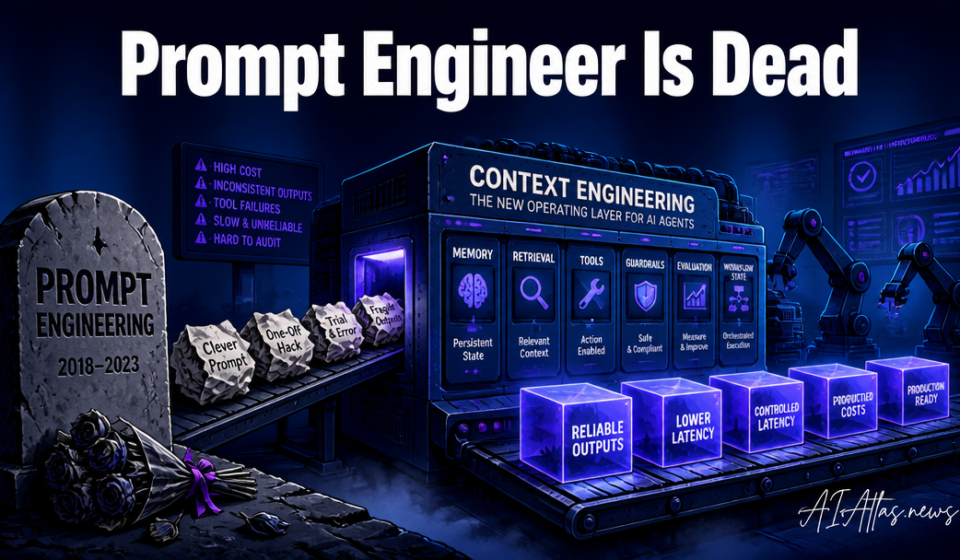
Our editorial read is simple: the market is maturing from one-off prompt craft into context engineering—the disciplined design of memory, retrieval, tool access, guardrails, evaluation loops and workflow state that makes AI agents dependable enough for production.
The commercial lens is cost and control. If you can’t bound latency, cap spend per task, detect failures early, and demonstrate improvements with evidence, you’re competing in the worst possible way: with more creativity, not more reliability. Buyers will pay for measurable behaviour change; they won’t pay for “prompt ingenuity” after the demo.
Prerequisite Checklist
Before you write a single orchestration layer, we insist you set guardrails around scope and accountability. Context engineering is not a prompt-writing exercise; it’s an end-to-end system design exercise with testability as a first-class requirement.
Here’s the prerequisite checklist we see winning teams run through early:
- Use-case boundaries: one workflow with a clear success definition (not “help users”)
- Data inventory: what content can be retrieved, where it lives, and what must never be exposed
- Tool catalogue: which actions are allowed (and who/what owns the API contracts)
- Cost model: how many turns, how often retrieval runs, and acceptable spend per task
- Failure taxonomy: what counts as hallucination, policy breach, wrong tool call, or silent non-compliance
- Evaluation target: precision/recall style criteria for answers and strict checks for tool actions
- Compliance posture: logging policy, retention rules, and red-team plan for edge cases
Sequence of Operations (Steps 1–5)
In our experience, the fastest path to production is counterintuitive: you design the context contract and the evaluation harness before you iterate on “better wording”. That’s how you prevent costly rewrites later when stakeholders demand reliability.
Follow this sequence of operations.
-
Define the workflow contract: inputs, outputs, allowed tools, and deterministic “state transitions” (what happens after each step).
Operator note: treat every step as if it will be audited. -
Design the context pack: specify what the agent receives each turn—retrieved snippets, relevant memory items, user constraints, and policy notes.
Operator note: managed context windows are a product feature, not a hidden implementation detail. -
Build retrieval and memory as pipelines: decide indexing strategy, ranking method, freshness rules, and memory write/read policies.
Operator note: avoid “bag of transcripts” memory; it inflates context, increases cost and degrades accuracy. -
Implement tool routing with checks: constrain when tools may be called, validate parameters, and add confirmation steps for high-risk actions.
Operator note: most enterprise incidents we’ve seen come from optimistic tool calls, not bad language generation. -
Install an evaluation loop from day one: create golden sets, run regression tests on every change, and measure both answer quality and “action correctness”.
Operator note: if you can’t run it automatically, it’s not an evaluation system—it’s a demo ritual.
Common Failure Points
Prompt engineering tends to tempt teams into local optimisation. You tune phrasing until it “feels” better, then discover the workflow fails under real variability—missing data, changed formats, conflicting instructions, and user retries.
Here are the failure points that most reliably burn cash:
- Semantic rebranding without operational change: swapping terminology while leaving context windows, retrieval and tool routing as ad hoc decisions.
- Unbounded context growth: letting memory and retrieved text expand until costs spike and answers degrade.
- Tool calls without validation: no schema checks, no permission gates, and no “safe fallback” when a tool call is uncertain.
- Evaluation that measures the wrong thing: testing only final text quality while ignoring intermediate state, routing accuracy, and policy compliance.
- Observability treated as an afterthought: lack of traceability means you can’t explain failures, so you can’t reliably improve.
- Vendor lock-in through opaque orchestration: architecture tied to a single platform’s abstractions, making future cost and model strategy changes painful.
Comparison: DIY vs Outsource
Entrepreneurs ask us whether to build orchestration in-house or contract it. We judge this less on capability and more on learning velocity and accountability: who will own the evaluation system, the incident response, and the cost model?
Use the table below as a practical decision aid.
| Criterion | DIY | Outsource |
|---|---|---|
| Time to first working agent | Slower (you must design evaluation and context contracts) | Faster for prototypes, slower to reach reliability |
| Reliability evidence (eval coverage) | Higher likelihood, if you treat testing as core work | Often limited unless you demand regression gates |
| Cost control (tokens, retrieval frequency, turn caps) | Better if owned internally and instrumented deeply | May optimise locally; global cost model can lag |
| Knowledge transfer & IP ownership | Strong—architecture and learning stay with your team | Risk—handover quality varies; costs accrue for changes |
| Long-term iteration speed | Best—teams iterate against their own failure data | Decent initially; degrades when requirements evolve |
Visualised Workflow Roadmap
The trick is to treat agent development as a delivery pipeline, not a series of prompt tweaks. We’ve found teams progress faster when every stage has a measurable “exit criteria” and a defined rollback plan.
Below is our recommended progression, from prototype to production-grade context engineering.
1) Freeze the workflow contract
2) Specify the context pack (memory + retrieval)
3) Gate tool access and validate parameters
4) Run regression evals on every change
5) Instrument traces and cost per task
Verification & Success Metrics
Reliability is not a feeling; it’s a set of measurable controls. We recommend you define success metrics for three layers: language output quality, action correctness, and operational performance (cost and latency).
Use metrics that map directly to stakeholder pain:
- Answer quality: task completion rate, groundedness checks, and “no unsupported claims” rate.
- Action correctness: tool-call validity (schema pass rate), correct routing rate, and “no forbidden actions” rate.
- Context discipline: average context tokens per task, retrieval precision@k proxy, memory read/write correctness.
- Operational performance: p95 latency, token spend per workflow run, and retry rate under user variance.
- Safety & policy: policy breach count per 1,000 runs and time-to-detect in monitoring.
If you can’t explain why the agent failed in a trace, you don’t yet have an enterprise system—you have an experiment with expensive anecdotes.
The Long-Term Maintenance Plan
Context engineering creates ongoing obligations. Your retrieval index will drift, policies will change, tool schemas will evolve, and model behaviour will shift. Treat maintenance like infrastructure work, not “occasional prompt updates”.
Our maintenance plan is built around four recurring loops:
- Evaluation regression cadence: weekly automated runs for quality + action correctness; monthly golden-set expansion.
- Cost monitoring: track cost per task by route, turn count, and retrieval frequency; alert on regressions.
- Policy and guardrail audits: re-run red-team scenarios after policy changes and after tool contract updates.
- Observability hygiene: ensure traces include workflow state, chosen retrieval chunks, tool decisions, and final policy outcomes.
Most importantly, budget for change. The teams that win aren’t the ones that shipped the fanciest agent; they’re the ones that build a reliable operating system for agent behaviour—then keep it reliable.
Frequently Asked Questions
- What’s the practical difference between prompt engineering and context engineering?
- Prompt engineering tunes surface instructions, while context engineering designs what the system receives, how it retrieves and remembers, and how it routes tools under policy.
- How do we avoid “demo-only” agent builds?
- Require an evaluation harness with regression tests, action correctness checks, and cost/latency budgets before you expand beyond the initial workflow.
- Should we store agent memory for every user?
- Not automatically. Write memory only when it meets explicit criteria, and cap context growth so retrieval and memory don’t quietly erode quality and inflate spend.