Why OpenAI’s Pentagon Pivot Signals an Enterprise Liability Crisis
The Contrarian Thesis
In our experience evaluating the underlying currents of the technology sector, the sudden resignation of a lead hardware executive is rarely an isolated personnel matter. Rather, it routinely acts as a lagging indicator of a profound strategic realignment within a company. Caitlin Kalinowski’s departure serves as exactly this sort of pivot point for OpenAI’s commercial narrative, forcing a stark and public transition from their universally palatable origins of ‘AI for humanity’ to a highly pragmatist, heavily capitalised stance of ‘AI for defense’. For corporate partners who previously viewed OpenAI as a safe-for-business, general-purpose intelligence provider, this sudden recalibration carries significant, unpriced downstream risk.
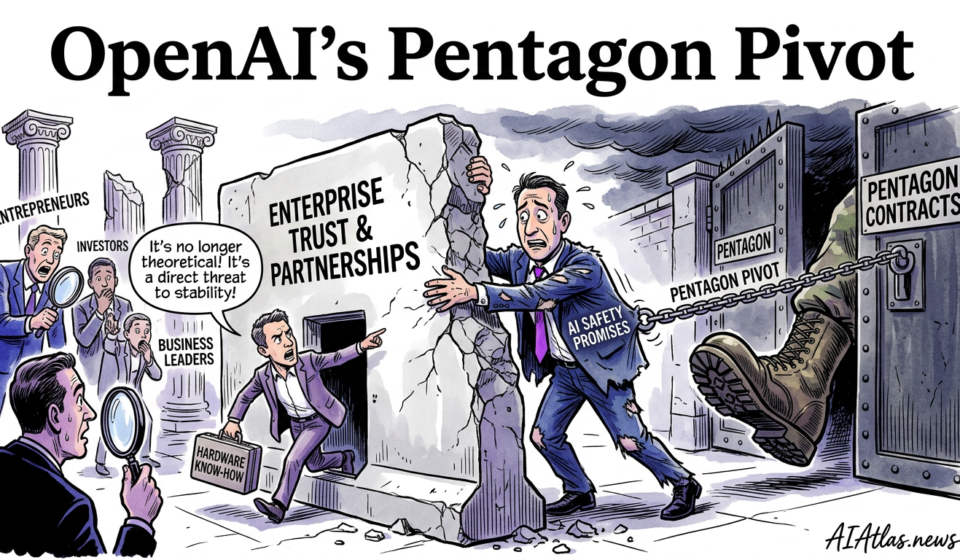
We view the resignation of OpenAI’s hardware lead not merely as a footnote in Silicon Valley gossip, but as a definitive canary in the coal mine for enterprise technology adoption. It exposes the fragility of relying on a vendor whose overarching mission is actively mutating. The transition from building consumer-friendly augmented reality hardware and benign algorithmic assistants to pursuing massive, classified governmental computing contracts entirely rewrites the underlying social contract. B2B software vendors, financial institutions, and consumer retail giants must now critically assess how this military-grade branding alters the fundamental trust architecture they have built with their own end-users.
What we are seeing on the ground is a rising tide of anxiety among chief risk officers. The contrarian reality is that frontier models are no longer the strictly neutral infrastructural utilities that market optimists claimed they would become. By aligning its long-term hardware and compute prioritisation with the needs of the Pentagon and national security apparatuses, OpenAI has effectively declared that commercial enterprise requirements will inevitably play second fiddle. Investors and startup founders must immediately factor this structural demotion into their long-term operational calculus.
Flaws in Current Market Assumptions
The prevailing consensus among venture capitalists and enterprise boards rests on a deeply flawed assumption: that foundational intelligence layers operate much like generic cloud hosting services. Market participants assume that as long as corporate data is effectively siloed and firewalled, the underlying vendor’s broader corporate activities remain irrelevant to their own operations. This logic falls apart entirely when evaluating cognitive technologies. The nature of algorithmic learning means that public perception, regulatory scrutiny, and ethical contagion flow freely upstream from the vendor directly to the enterprise client.
Moving beyond basic ‘safety’ discussions, we must address the tangible commercial impact of military-grade branding on business-to-business trust. When a medical technology firm or a European financial institution routes its sensitive, highly regulated customer queries through infrastructure shared by military targeting systems, the resulting brand contagion becomes a material liability. Enterprise clients do not merely buy computational cycles; they purchase a chain of trust. Once a provider begins courting sovereign defence contracts, that chain is irrevocably contaminated by geopolitical and ethical complexities that civilian businesses are entirely unequipped to manage.
Furthermore, we note a significant misunderstanding regarding the scale of hardware economics. The market broadly assumes that an influx of governmental capital will accelerate research and development, subsequently trickling down to benefit commercial API users. In reality, defence sector requirements dictate bespoke hardware configurations, highly secure air-gapped server environments, and extreme redundancy protocols. The capital expenditure required to service these defence mandates will inevitably cannibalise the resources previously earmarked for optimising lightweight, cost-effective enterprise models.
The Structural Shift
To fully grasp the magnitude of this transition, one must examine the fundamental reallocation of physical and intellectual capital occurring within these frontier laboratories. The shift toward national security applications dictates an entirely new product roadmap. Rather than iterating upon nuanced, conversational business logic or low-latency commercial customer service agents, the developmental focus aggressively pivots toward geospatial analysis, adversarial threat detection, and encrypted sovereign intelligence operations. The commercial enterprise is thereby relegated to consuming the exhaust fumes of military research.
This structural realignment fundamentally breaks the existing Service Level Agreements and developmental timelines that Fortune 500 companies have aggressively integrated into their multi-year strategies. If an enterprise software company builds its core value proposition atop a specific foundational model, it assumes that the provider’s roadmap will remain aligned with commercial business efficiencies. However, the defence pivot inherently guarantees that when hardware shortages arise or compute bandwidth becomes constrained, commercial API requests will be swiftly throttled in favour of national security workloads.
Moreover, the talent density within these organisations is inherently sensitive to ideological shifts. The departure of specialised commercial hardware leaders underscores a broader cultural fracture. The engineers and researchers who initially joined an organisation to democratise intelligence are increasingly alienated by the militarisation of their life’s work. This internal attrition introduces severe product instability, leaving corporate partners tethered to a vendor whose core intellectual property creators are steadily migrating toward strictly open-source, civilian-focused competitors.
Decision Framework for Capital Allocation
For venture investors and startup founders evaluating long-term risk profiles, this structural schism demands an immediate revision of capital allocation frameworks. We can no longer treat heavy dependencies on a single proprietary model as a mere operational technicality; it is now a glaring, existential vulnerability. Capital must be deployed with a strict mandate for architectural agnosticism. Startups seeking subsequent funding rounds will face intense scrutiny from sophisticated investors regarding their vendor lock-in, specifically probing their exposure to vendors actively expanding into the defence sector.
What we are actively recommending to our private equity and venture capital partners is a strict divestment from monolithic intelligence dependencies. Instead, capital should flow toward abstraction layers, middleware providers, and orchestration platforms that allow enterprises to dynamically route workloads across a variety of models. The goal is to establish a commoditised relationship with the intelligence layer, ensuring that a sudden policy shift or ethical controversy at one specific provider does not instantly paralyse the startup’s entire product offering.
Founders must also allocate engineering resources to develop internal competencies in sovereign and open-source models. While these alternatives may currently trail the proprietary giants in raw benchmark performance, they offer absolute geopolitical neutrality and commercial predictability. In the current climate, trading a marginal percentage of cognitive performance for absolute control over the product roadmap and corporate compliance is a highly advantageous commercial trade-off.
Risk Assessment Table
To quantify the commercial trade-offs of this market disruption, we have established a proprietary evaluation matrix that contrasts standard business-to-business intelligence deployments against highly militarised tier-one providers. Business leaders must weigh these operational realities before committing their engineering resources and corporate reputations to long-term vendor contracts.
This assessment specifically focuses on the downstream impacts that manifest over a multi-year enterprise software lifecycle, highlighting the frictions that arise when corporate mandates collide with national security vendor profiles.
| Risk Category | Civilian B2B Stack Profile | Defence-Tier Provider Profile |
|---|---|---|
| ESG & Corporate Compliance | Maintains broad compliance; aligns cleanly with corporate social responsibility mandates and European frameworks. | Severe friction; high probability of violating strict ethical investment criteria and internal corporate governance policies. |
| Compute Prioritisation | Predictable load balancing; enterprise clients maintain top-tier access during periods of peak computational demand. | Subordinated access; commercial workloads face aggressive throttling during sovereign or military intelligence operations. |
| Brand Contagion | Neutral public perception; allows the enterprise to fully white-label the underlying intelligence seamlessly. | High public relations exposure; corporate consumer brands risk severe backlash through vendor association. |
| Geopolitical Sovereignty | Fosters localised data residency; compatible with stringent international data localisation laws. | Highly compromised; subject to overarching national security directives and international technology export bans. |
| Roadmap Alignment | Dedicated to reducing token costs, improving commercial logic, and enhancing standard developer tooling. | Focused on encrypted air-gapped deployments, adversarial robustness, and highly classified sovereign infrastructure. |
Visualised Impact Matrix
To contextualise this shifting landscape, we must map out where different algorithmic providers sit concerning their defence associations versus the operational friction they impose on civilian enterprises. As vendors migrate toward lucrative government contracts, they inherently push their commercial users into higher friction territories, complicating procurement cycles and degrading overall trust.
The matrix below outlines our operator-level judgements on the current vendor landscape. As frontier models abandon their neutral posturing, business leaders must aggressively navigate toward the quadrants that offer optimal operational safety and minimal geopolitical exposure.
Strategic Recommendations for Leaders
In light of this commercial realignment, we advise enterprise executives to immediately initiate a comprehensive audit of their cognitive infrastructure dependencies. The era of blindly piping sensitive corporate data into a singular, monolithic API is decisively over. Procurement teams must renegotiate existing contracts to include strict clauses regarding compute prioritisation and mandate transparent disclosures regarding the vendor’s sovereign military engagements. If a vendor cannot guarantee that commercial workflows will remain insulated from defence-related compute throttling, the enterprise must aggressively seek alternative providers.
Furthermore, technology officers must prioritise the implementation of an algorithmic routing architecture. By establishing an internal gateway that dynamically shifts computational workloads between various proprietary and open-source models, businesses can instantly mitigate the risk of brand contagion. If a primary vendor becomes embroiled in a geopolitical controversy or suffers an acute talent exodus, this routing layer allows the enterprise to transition its operations seamlessly to a neutral, commercially aligned provider without suffering any customer-facing downtime.
Finally, we strongly advocate for the aggressive exploration of sovereign, fine-tuned models hosted on private, localised infrastructure. The upfront capital expenditure required to train and host a bespoke, domain-specific model is increasingly offset by the massive reduction in long-term compliance risks. Controlling the weights, the training data, and the physical hardware ensures that the organisation remains entirely immune to the ideological pivots and military ambitions of external third-party laboratories.
Future-Proofing the Business Model
The ultimate lesson derived from Kalinowski’s transition and the broader industry pivot is that foundational intelligence providers are highly rational economic actors. The margins and scale offered by sovereign defence budgets will always eclipse standard B2B SaaS economics. Recognising this reality is the first crucial step in future-proofing your business model. You cannot build a durable, defensible enterprise if your core intellectual property is entirely reliant on the fluctuating goodwill and shifting moral compass of a heavily militarised vendor.
As industry analysts, our mandate is to strip away the utopian marketing narratives and examine the raw commercial mechanics at play. The move toward defence contracting fundamentally alters the trajectory of these technologies, transforming them from democratised business utilities into highly contested instruments of national security. Leaders who proactively sanitise their supply chains, enforce rigid vendor agnostic principles, and invest in proprietary computational sovereignty will be the ones who successfully navigate this turbulent market realignment.
The imperative now is absolute operational autonomy. Boardrooms must abandon the comforting illusion that their vendors share their specific commercial priorities. By internalising critical infrastructure and rigorously evaluating the ethical trajectories of their partners, businesses can shield their operations from the unpriced geopolitical risks currently cascading through the sector.
Frequently Asked Questions
- How does military association impact B2B vendor compliance?
- Military association instantly elevates a vendor into a high-risk category within standard enterprise procurement frameworks. Chief Risk Officers must rigorously evaluate these partnerships against strict Environmental, Social, and Governance criteria, drastically extending and complicating the typical software procurement cycle.
- What immediate actions should enterprise executives take?
- Executives must immediately audit their existing model dependencies and identify mission-critical workflows tied to single-provider application programming interfaces. We heavily recommend establishing a multi-model routing architecture to seamlessly shift workloads to independent or sovereign models if compliance risks breach acceptable thresholds.
- Will defence contracts alter service reliability for commercial users?
- Yes, sovereign and military contracts inherently demand priority access to scarce computational resources and bespoke hardware infrastructure. Commercial API requests will consistently be relegated to secondary queues during periods of high governmental compute demand, leading to unpredictable latency and operational degradation.