
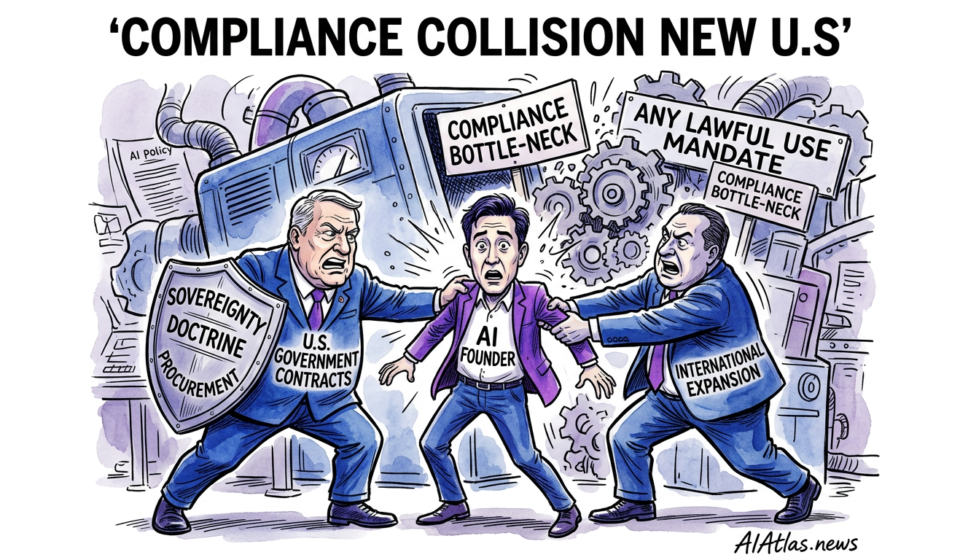
The Compliance Collision: Why the New U.S. ‘Any Lawful Use’ Mandate Forces a Hard Choice for AI Founders
We do not read the White House draft as an openness manifesto. We read it as a sovereignty doctrine expressed through procurement. Requiring federal AI vendors to provide unrestricted access to model weights and architectures is not a philosophical nod to transparency; it is the state asserting that systems used in government must be inspectable, modifiable and aligned to domestic priorities, even if that collides with how commercial model companies protect their margins. The common market take is that this will reward the most transparent vendors. Our view is harsher: it will punish any company still pretending one global model strategy can serve Washington, Brussels and multinational enterprise buyers without painful compromise.
That is why we see this directive as a pivot point for product roadmaps, not a policy footnote. If the draft survives in anything close to its present form, founders will have to choose whether federal revenue justifies exposing the most sensitive layer of their stack. For some, the answer will be yes, but only through a ring-fenced federal fork. For others, the smarter move will be to walk away from procurement and protect global market access. In our experience, markets tend to underprice these moments until they show up in sales cycles, diligence rooms and suddenly more expensive engineering plans.
Flaws in Current Market Assumptions
The first flawed assumption is that regulatory gravity still points towards convergence. It does not. The draft explicitly rejects the idea that federal AI should inherit foreign-aligned constraints such as the EU AI Act as the default organising logic. That matters because many boards have funded compliance as if the end state were a broad middle ground: one model, one governance programme, one documentation layer, sold everywhere. What we are seeing instead is divergence at the level that hurts most: training governance, weight access, auditability, deployment controls and alignment objectives. That is not a paperwork problem. It is a product design problem.
The second flawed assumption is that federal adoption automatically strengthens enterprise sales elsewhere. Often it does, but not when government procurement asks for concessions that commercial buyers and foreign regulators interpret differently. A global bank may ask whether architecture disclosure creates new operational risks. A European customer may question whether a federal-tuned model can satisfy local risk expectations. A strategic partner may object to onward access rights they never intended to grant. We think too many operators still treat “federal approved” as a universal badge of trust. Under this regime, it may instead signal a very specific set of trade-offs.
The Structural Shift
The deeper shift is economic. If unrestricted weight and architecture access becomes the price of admission for a meaningful slice of US federal work, the defensibility of pure model ownership weakens in that segment. We would expect value to migrate upwards and outwards: orchestration layers, secure deployment, domain data, retrieval pipelines, audit tooling, red-teaming, human review systems and contractual wrappers that make a model operationally useful inside government. In other words, the moat moves from “we alone own the model” to “we alone know how to deploy, monitor and adapt it under hard constraints”. That is a very different investment case.
We are already seeing three strategic camps emerge. First, sovereign-stack builders willing to create bespoke federal products with deeper disclosure and tighter domestic alignment. Second, neutral infrastructure and governance vendors who profit from fragmentation without owning the contested model layer. Third, application companies that sidestep the fight entirely by specialising in workflow, data and vertical outcomes. If we were advising operators on roadmap discipline, we would say this plainly: the era of the elegant single-stack story is ending. The winners will be those prepared to run multiple policy, pricing and model assumptions at once.
Decision Framework for Capital Allocation
For founders and investors, the capital question is not whether this directive is fair. It is whether federal revenue can justify the engineering duplication, legal exposure and product complexity it introduces. We would start with four tests. First, how large is the realistic federal pipeline over the next thirty-six months, not the slideware number. Second, can the company preserve commercial differentiation if weights and architecture become inspectable by the buyer. Third, will core partners, model licensors or cloud dependencies even permit this level of access. Fourth, can leadership run two compliance narratives at once without slowing product velocity to a crawl.
Our rule of thumb is simple. If federal contracts are likely to represent a strategic, recurring and referenceable revenue stream, then a dedicated procurement path may deserve investment. If not, do not contaminate the global roadmap for a market you are unlikely to win at scale. We have watched too many companies spend heavily to look “federal ready” only to discover that sales cycles are slow, integrations are bespoke and the procurement team has effectively become the product manager. Capital should flow towards optionality: modular architectures, portable governance, configurable alignment layers and commercial terms that preserve IP where possible.
Risk Assessment Table
The most useful way to assess the directive is to compare strategic postures rather than debate the politics. Below is the operator view we would use in a board meeting when deciding whether to chase federal procurement, protect international distribution, or split the business model before the market forces the issue.
| Strategic posture | Federal fit | Global enterprise fit | Margin risk | Our judgement |
|---|---|---|---|---|
| Single closed global model | Low | Medium to high | Low initially, higher if forced to adapt later | Clean story, but exposed if procurement pressure expands |
| Dedicated federal model fork with weight access | High | Medium | High | Viable only if contract volume is substantial and durable |
| Modular dual-stack architecture | Medium to high | High | Medium | Most balanced route for scaled operators |
| Open-weight base model plus proprietary control plane | High | Medium to high | Medium | Strong if the moat truly sits above the model |
| Infrastructure and governance supplier | Medium | High | Low to medium | Quietly attractive as fragmentation increases |
The table makes one point clear: the old assumption that closed-model vendors sit in the strongest strategic position is weakening. In a world where one major buyer demands deep inspectability and another major market demands extensive risk controls of a different kind, the premium shifts to modularity. We would rather back a company that can isolate policy-sensitive components than one that insists every customer must accept the same architecture, disclosures and alignment defaults.
It also shows why investors should stop equating openness with commoditisation. Open weights can compress some model-layer margins, but they can also accelerate trust, shorten evaluation cycles and create room for premium governance, integration and support. The wrong question is whether access destroys value. The right question is where value re-forms after access becomes a procurement condition.
Visualised Impact Matrix
To simplify the commercial choices, we map the main roadmap options against two variables: commercial upside and execution burden. For most teams, this is a better planning tool than abstract debates about whether policy intervention is good for innovation.
Execution burden increases →
Compliance orchestration layer
Upside: 8/10
Burden: 4/10
Dedicated federal model fork
Upside: 9/10
Burden: 8/10
Global closed model only
Upside: 4/10
Burden: 3/10
Reactive multi-region customisation
Upside: 5/10
Burden: 9/10
Execution burden: Higher
The trap is the bottom-right quadrant. Many companies will drift there by accident: not because they chose a federal strategy, but because they bolt on exceptions for agencies, European clients and strategic accounts until the roadmap becomes a patchwork of contradictory commitments. We have seen this pattern before in cloud security and data residency. It starts as enterprise responsiveness and ends as margin erosion disguised as customer centricity.
The most investable space, in our view, is the upper-left quadrant. Governance layers, policy controls, evaluation frameworks and secure deployment systems benefit from fragmentation without having to win the raw model race. They also travel better across jurisdictions. That matters when one regulator wants more transparency, another wants more procedural safeguards and the buyer simply wants a system that works without creating a board-level incident.
Strategic Recommendations for Leaders
If we were in the room with founders and CTOs this week, our first recommendation would be to separate product ideology from revenue strategy. You do not need to become an open-weight evangelist to serve the federal market, but you do need to know exactly which parts of your stack can be disclosed, inspected or replaced. That means rewriting vendor agreements, reviewing licence terms, stress-testing data provenance and mapping architecture dependencies long before procurement asks the question. Our second recommendation would be to create a board-approved threshold for federal exposure. If the revenue opportunity does not cross that threshold, protect the global roadmap and move on.
For investors, the diligence lens also needs to change. We would probe not just model quality and enterprise pipeline, but contractual rights over weights, architectures, training components and downstream deployment. We would ask whether the company can support policy divergence without doubling headcount in compliance and platform engineering. Most of all, we would look for evidence that management understands where margins will come from when the model itself is no longer the only scarce asset. Teams that still pitch “best model wins” are, in our view, behind the curve.
Future-Proofing the Business Model
The durable response is not to guess which regulator will dominate. It is to design a business that survives regulatory pluralism. That means modular model serving, clearly separable safety layers, auditable evaluation pipelines, flexible deployment choices and commercial terms that distinguish between inspection rights, use rights and redistribution rights. It also means investing in the unglamorous layers: observability, policy engines, access control, incident response and customer-specific alignment tooling. These are not side features. They are where a large share of long-term enterprise value is likely to settle.
Our closing judgement is straightforward. The White House draft is a warning shot against the fantasy of a single, frictionless AI market. Federal procurement is starting to demand domestic control, while other jurisdictions are demanding their own forms of accountability. Companies that adapt early will not merely survive the split; they will price it into product design, sales strategy and capital planning before rivals do. In our experience, that is how real category leaders are built: not by chasing every market with the same product, but by knowing exactly which compromises create durable revenue and which simply dilute the business.