
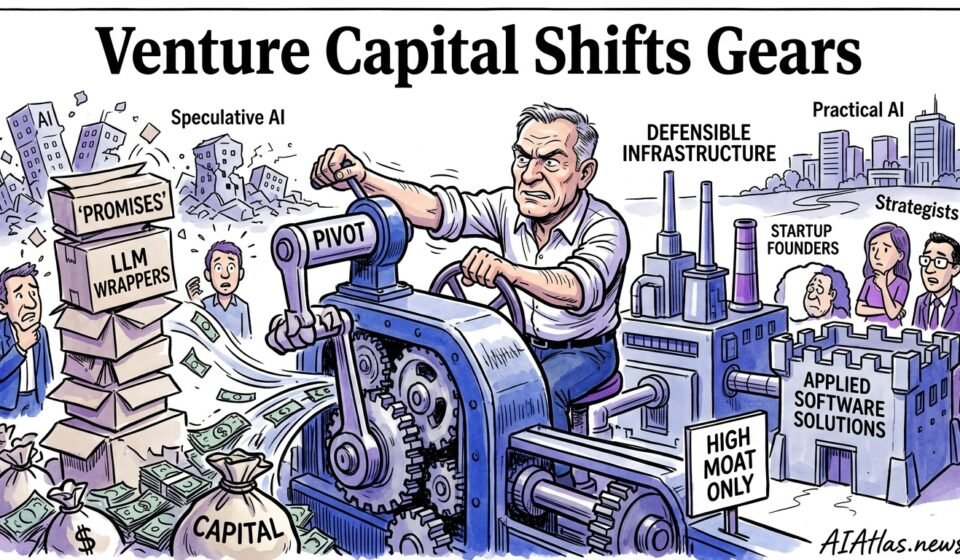
Venture Capital Shifts Gears: AI Investment Pivots from ‘Promises’ to Practical Infrastructure and Applied Software
The Headline Truth
In our analysis of the most recent Q3 and Q4 venture capital data, a stark commercial reality has emerged: the speculative froth that characterised early generative artificial intelligence investments has decisively evaporated. We are no longer witnessing a market willing to fund thin interfaces built atop third-party large language models. Instead, capital is executing a hard pivot toward mature, defensible enterprise platforms.
What we are seeing is a structural flight to quality, manifested in a sharp contraction of early-stage seed rounds for conceptual generative startups. Simultaneously, a corresponding surge in Series B and subsequent rounds for sector-specific, B2B infrastructure solutions has reshaped the venture landscape. The era of cheap capital subsidising simple application programming interface calls is officially over, replaced by a rigorous demand for proprietary data and workflow dominance.
Context Others Missed
Many mainstream commentators have interpreted the drop in early-stage deal volume as a cooling of broader interest in artificial intelligence. We argue this is fundamentally incorrect. The contraction does not signal a retreat from the technology itself; rather, it indicates a maturation of venture mandates. Investors have collectively recognised that foundational model providers will inevitably commoditise basic text and image generation, effectively destroying the margins of startups that lack deep, sector-specific workflows.
Beneath the headline figures, the true context lies in the shift toward infrastructural defence. Venture capital firms are tightening their operational parameters, aggressively migrating capital away from consumer-facing novelty applications toward high-moat applied software. They are actively seeking founders who are solving complex, highly regulated enterprise problems—such as legal document analysis, clinical trial matching, or industrial supply chain optimisation—where the technology acts as an enabler rather than the entire product.
The Commercial Ripple Effect
This reallocation of capital creates immediate consequences for founders navigating the current funding cycle. Startups must radically adjust their growth roadmaps to align with tightening market expectations. It is no longer sufficient to demonstrate impressive user acquisition metrics if those users are generating negative gross margins due to high compute costs. Founders are now required to show a clear, accelerated path to profitability and deeply embedded commercial utility.
Furthermore, enterprise buyers are displaying severe fatigue with disjointed, single-feature point solutions. Chief Information Officers are consolidating their technology stacks, demonstrating a clear preference for robust platforms that integrate seamlessly into legacy corporate systems. If a startup cannot prove that its product replaces an existing, expensive enterprise workflow or definitively secures proprietary commercial data, it will find both customer acquisition and venture capital nearly impossible to secure.
Stakeholder Impact Analysis
For venture capitalists, the current environment demands defensive growth strategies. We note that established funds are choosing to write substantially larger cheques for a smaller, highly vetted cohort of companies at the Series B stage and beyond. This concentration of capital is designed to back outright category winners that have already survived the brutal early-stage product-market fit gauntlet, insulating the fund from the high mortality rate of the seed ecosystem.
Corporate strategists, on the other hand, are presented with a unique and highly lucrative commercial environment. As seed-stage capital dries up for thin software wrappers, a significant number of early-stage startups will face an existential runway crisis. Forward-thinking corporate development teams are already capitalising on this distress, executing targeted acqui-hires to absorb top engineering talent and intellectual property at a fraction of last year’s speculative valuations.
Strategic Comparison Table
To clearly define the operational shift occurring in the private markets, we have mapped the core criteria that venture capitalists evaluated during the initial investment boom against the stringent requirements mandated in the current Q3/Q4 environment.
This strategic realignment highlights exactly where founders must position their product roadmaps to successfully capture institutional capital in the coming fiscal year.
| Commercial Metric | Previous Speculative Model | Current Rigorous Mandate |
|---|---|---|
| Core Technology Focus | Thin interfaces and basic prompt wrappers | Proprietary infrastructure and fine-tuned models |
| Target Market Strategy | Broad consumer applications | Sector-specific B2B enterprise solutions |
| Defensibility & Moat | First-mover advantage and user interface | Proprietary data sets and deep system integration |
| Capital Efficiency | High compute burn for user acquisition | Path to profitability with strong gross margins |
| Typical Funding Stage | Oversubscribed Seed and Series A | Concentrated Series B+ capital deployments |
Visualised Market Response
The timeline below illustrates the sequential migration of venture capital focus over the past eighteen months. This visualises the precise trajectory from initial consumer hype to the current demand for robust enterprise architecture.
Understanding this progression is vital for founders attempting to anticipate where institutional capital will flow next, allowing them to structure their pitches around infrastructural permanence rather than transient novelty.
Critical Market Risks
While this rationalisation of the market is structurally sound, we must highlight the severe concentration risk it introduces. With so much institutional capital suddenly chasing a highly restricted pool of “safe” Series B enterprise companies, valuations at the later stages are being driven to multiples that may prove unsupportable. Investors risk recreating the exact valuation bubbles they sought to escape, merely displacing the froth from the seed stage to the growth stage.
Additionally, we foresee a prolonged period of innovation starvation at the absolute earliest stages. By categorically shunning conceptual seed rounds, the venture ecosystem risks choking off the supply of foundational breakthroughs that require long-term, patient capital. If funds refuse to underwrite technical risk today, they will inevitably find themselves lacking mature, defensible platforms to back in three years’ time.
Conclusion and Future Outlook
In our experience, markets that mature this rapidly leave a trail of obsolete business models in their wake. The Q3 and Q4 data unequivocally confirms that the venture community has established a new baseline for what constitutes a fundable business. Mere technological capability is insufficient; commercial viability, deep enterprise integration, and structural defensibility are the non-negotiable prerequisites for institutional support moving forward.
Founders must ruthlessly audit their operational models, excising features that are easily replicated by foundational model updates. Investors and corporate strategists should remain highly disciplined, focusing their attention on platforms that command proprietary workflows. The speculative phase is finished; the era of commercial execution has begun.
Frequently Asked Questions
- Why has seed funding for artificial intelligence startups decreased?
- Investors have recognised that many early-stage applications lack proprietary data moats and are highly vulnerable to basic updates from foundational model providers. Consequently, venture capital has retreated from funding easily replicable software in favour of more defensible platforms.
- What constitutes a defensible moat in the current market?
- A defensible moat now requires deep integration into complex enterprise workflows, proprietary sector-specific training data, or ownership of a heavily regulated process. Simply providing a slick interface over a third-party language model is no longer sufficient to attract capital.
- How should enterprise strategists react to this shift?
- Strategists should actively monitor the distressed seed-stage market for acquisition opportunities, targeting talented engineering teams whose consumer-facing products have stalled. Simultaneously, they must focus internal adoption entirely on mature, highly secure B2B platforms.