
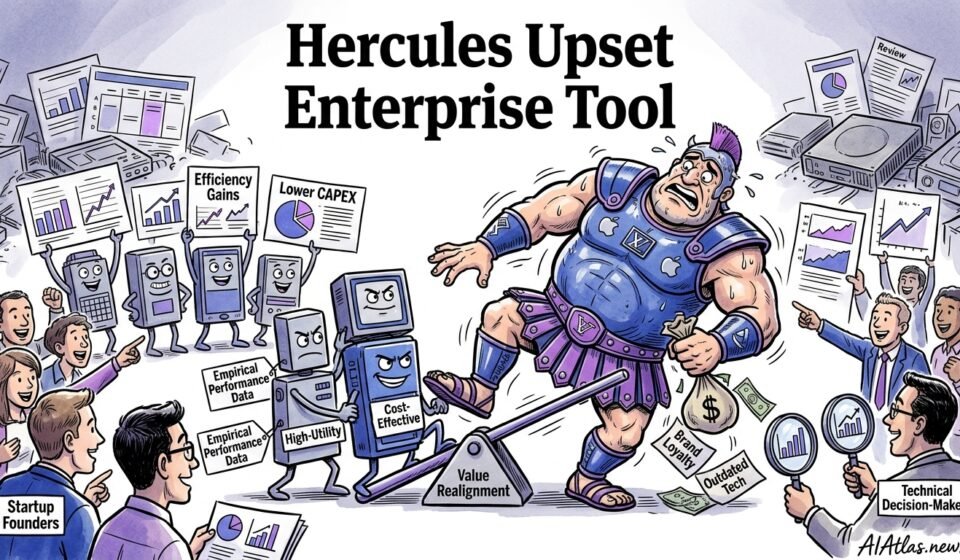
The Hercules Upset: Why Enterprise Tool Stacks are Facing a Value Realignment
The Contrarian Thesis
In our experience, operational scaling within automation and robotics start-ups is frequently derailed by an outdated procurement philosophy. Hardware architecture is the physical bedrock upon which intelligent software systems operate, yet technical decision-makers routinely default to legacy premium brands, mistakenly correlating high capital expenditure with reliability. Recent independent lab benchmarks have entirely dismantled this assumption. The empirical data confirms that the Hercules 20V brushless architecture effectively matches and occasionally exceeds the torque output of the Milwaukee M18 Fuel series.
What we are seeing is a profound structural realignment in how enterprise hardware is evaluated. For start-up founders and operations leads, this is not merely a debate about toolset brands; it is a critical lesson in capital efficiency. Funding that is unnecessarily diverted to premium badges is capital starved from core algorithmic development and system integration. When a challenger brand delivers identical throughput for a fraction of the unit cost, continuing to purchase the incumbent requires justifying an emotional tax rather than a strategic commercial investment.
Flaws in Current Market Assumptions
The enterprise procurement space is plagued by the persistent myth that brand heritage directly guarantees superior operational uptime. Managers tasked with equipping automated facilities or field maintenance fleets often rely on the historical safety of established names. They operate under the belief that selecting premium hardware inherently protects them from catastrophic failure rates or supply chain disruptions. This defensive strategy might have held water a decade ago, but component manufacturing methodologies have evolved, democratising access to high-grade materials and precision engineering.
This premium bias acts as a massive drain on operational expenditure. Incumbents charge a premium that disproportionately funds their marketing departments rather than reflecting actual manufacturing costs. We observe that businesses continuing to pay this premium are essentially subsidising a brand’s retail dominance while receiving no tangible increase in enterprise throughput. Clinging to brand loyalty over empirical performance metrics is an operational vulnerability that agile competitors are swiftly learning to exploit.
The Structural Shift
The market is rapidly transitioning from subjective brand allegiance to rigorous, data-driven hardware evaluation. Modern start-ups are applying the same analytical scrutiny to their physical infrastructure as they do to their software stacks. By conducting independent internal benchmarks, operations leads are discovering that budget-tier components frequently feature the exact same brushless motor architectures and lithium-ion cell configurations as their top-tier counterparts. The gap in actual utility has effectively closed.
This commoditisation of high-performance hardware closely mirrors the open-source movement in software development. Just as proprietary software models were forced to adapt to open-source alternatives offering equal efficiency, premium hardware brands must now contend with budget disruptors providing professional-grade torque and battery endurance. We maintain that this shift empowers agile companies to scale their physical operations at a vastly accelerated pace, directly translating saved capital into aggressive market expansion.
Decision Framework for Capital Allocation
Navigating this new hardware reality requires a sophisticated approach to capital allocation. Technical decision-makers must divorce their procurement strategies from institutional habits and institute strict empirical testing protocols. The primary metric for any hardware acquisition should be cost-per-unit of verifiable output, completely agnostic of the logo stamped on the casing. By demanding raw performance data, teams can accurately map their required throughput against the most capital-efficient solutions available.
Furthermore, leaders must cultivate a hybrid procurement model. While specific hyper-critical nodes might still necessitate bespoke premium components, the vast majority of operational infrastructure can be safely transitioned to high-performing challenger brands. This bifurcated approach ensures that maximum capital is preserved without sacrificing the systemic reliability required for complex automation tasks. It is an exercise in strategic precision, ensuring every pound spent yields the highest possible operational return.
Risk Assessment Table
When transitioning from established incumbents to high-performance challengers, operations teams must comprehensively evaluate the associated risks. The primary concern is rarely the baseline performance, but rather the peripheral logistics and long-term fleet management implications. We advise a thorough mapping of these operational realities before executing a broad procurement shift.
To assist in this evaluation, we have structured a comparative risk assessment. This framework isolates the core concerns associated with adopting budget-tier hardware in high-throughput enterprise environments, contrasting the incumbent reality with the challenger profile, and providing actionable mitigation strategies.
| Risk Category | Incumbent (Premium) | Challenger (Budget) | Mitigation Strategy |
|---|---|---|---|
| Hardware Failure Rates | Known and historically predictable | Equivalent in lab, untested long-term | Implement phased rollouts and stress tests |
| Warranty Logistics | Established enterprise SLA networks | Retail-focused, slower enterprise support | Over-provision units using saved CAPEX |
| Supply Chain Dependency | Robust global availability | Vulnerable to regional stockouts | Diversify suppliers and maintain internal buffers |
| Fleet Homogeneity | Single battery/charger ecosystem | Risk of fragmented battery platforms | Strictly standardise on the selected challenger |
| CAPEX Sunk Costs | High initial financial lock-in | Low barrier, easy fleet replacement | Treat hardware as depreciating consumables |
Visualised Impact Matrix
Understanding where a hardware architecture sits within the broader market context is essential for informed procurement. We frequently use a dual-axis evaluation to categorise equipment, measuring verifiable performance output against the total cost of ownership. This clearly delineates which tools are driving genuine value and which are merely resting on historical market positioning.
The visual matrix below maps the current hardware landscape. By plotting the premium incumbents against the emerging disruptive challengers, it becomes immediately apparent where modern enterprises should focus their capital expenditure to achieve maximum efficiency.
(High Cost, High Performance)
Milwaukee M18 Fuel
(Low Cost, High Performance)
Hercules 20V Brushless
(High Cost, Low Performance)
Outdated Tier 1 Ecosystems
(Low Cost, Low Performance)
Unbranded White-Label Imports
Strategic Recommendations for Leaders
For technical directors managing tight budgets, the mandate is clear: initiate internal, blind benchmarking protocols immediately. Procure a small sample of high-tier challenger units and deploy them alongside incumbent hardware in identical operational scenarios. By tracking degradation, maintenance cycles, and output efficiency without operator bias, businesses can build an incontrovertible dataset. This data becomes the foundation for drastically reducing future procurement budgets.
Armed with these empirical results, operations leads possess significant leverage. We strongly suggest using challenger benchmark data to aggressively renegotiate enterprise service agreements with established vendors. If an incumbent cannot justify their price premium through demonstrable throughput gains or superior SLA logistics, capital must be redirected. Start-ups cannot afford to subsidise inefficiency simply out of habit.
Future-Proofing the Business Model
Building a resilient hardware infrastructure requires architectural agility rather than rigid vendor lock-in. Companies that commit entirely to a single premium ecosystem frequently find themselves trapped when alternative technologies advance more rapidly. By designing field operations and automated systems to be platform-agnostic, businesses ensure they can seamlessly integrate the most cost-effective components the market dictates at any given moment.
Ultimately, commercial survival hinges on the ruthless pursuit of capital efficiency. The Hercules versus Milwaukee benchmark is merely a microcosm of a much broader industrial reality. We believe that leaders who adapt to this reality, prioritising data over brand prestige, will construct leaner, more aggressive organisations capable of dominating their respective sectors.
Frequently Asked Questions
- How does adopting budget-tier hardware impact long-term enterprise scalability?
- By drastically reducing initial capital expenditure, start-ups can allocate more funds toward core algorithmic growth and operational scaling. Provided the hardware meets verifiable benchmark standards, this accelerates expansion without compromising system integrity.
- What is the most significant operational risk when switching away from premium brands?
- The primary vulnerability lies in enterprise support logistics rather than hardware failure. Challenger brands often lack the robust, immediate replacement networks that established incumbents provide for large corporate clients.
- How should operations leads handle fragmented battery platforms during a transition?
- Teams must mandate strict standardisation once a challenger ecosystem is verified and selected. Maintaining multiple competing battery systems on a single factory floor introduces severe logistical inefficiencies that negate any initial cost savings.